
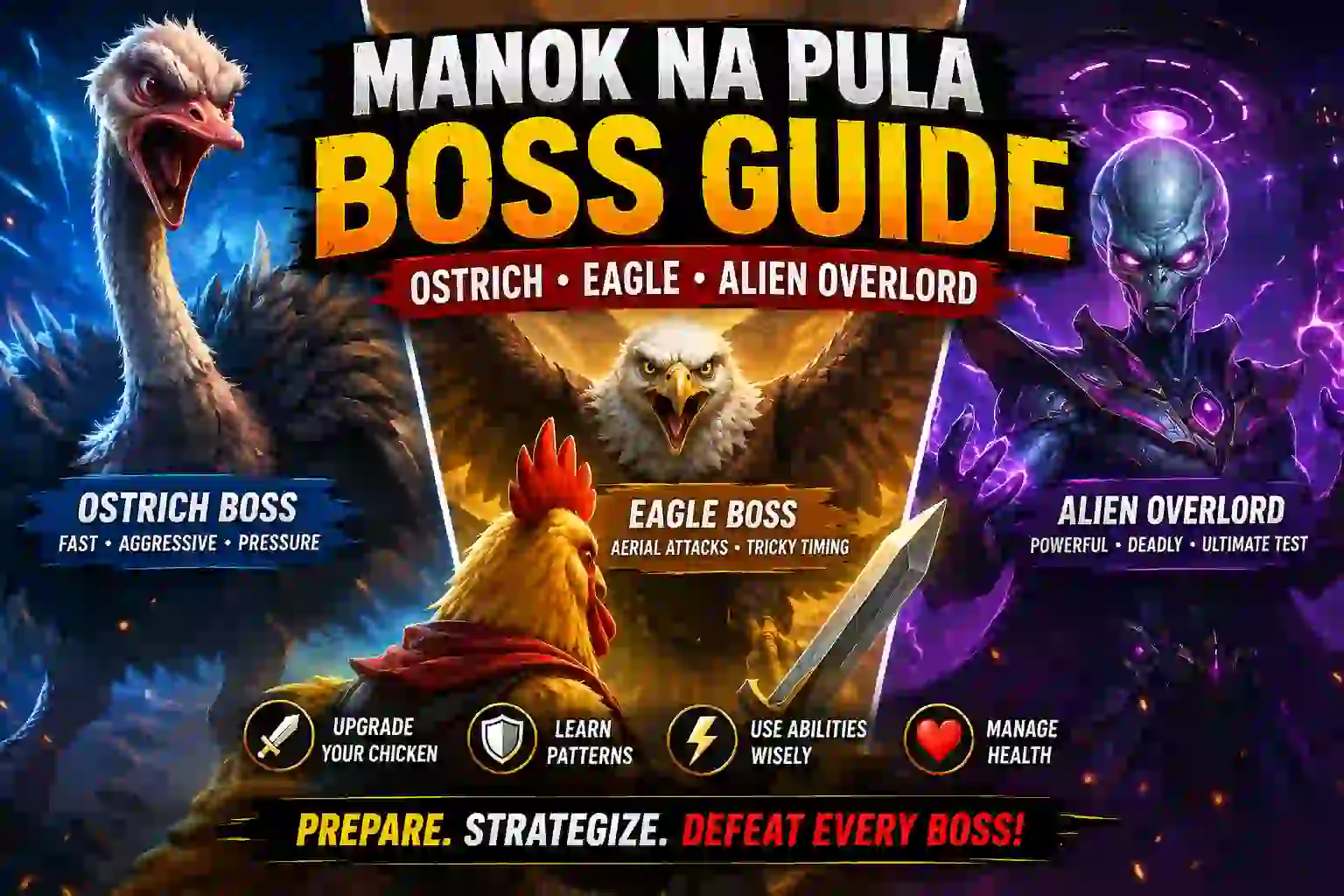
The Manok Na Pula bosses are designed to test different parts of your chicken build as you progress through the game. The Ostrich focuses on survivability and reaction timing, the Eagle introduces a stronger roster and evolution requirement, while the Alien Overlord puts your combat execution and timing to the final test.
This makes the boss ladder more than a simple progression of stronger enemies. Each fight introduces a different challenge, so the chicken and strategy that work against one boss may not be enough for the next.
Understanding these differences before entering a boss fight can help you choose the right chicken, upgrade the right stats, and avoid wasting valuable resources.
The Manok Na Pula Boss Ladder
The three main Manok Na Pula bosses can be approached as three different stages of progression.
The Ostrich is the first major challenge and emphasizes defensive preparation and reaction speed. The Eagle raises the difficulty by making chicken evolution and roster selection more important. The Alien Overlord is the final test, where accurate timing becomes more important than simply having high stats.
| Boss | Main Challenge | Recommended Focus |
|---|---|---|
| Ostrich | Fast close-range attacks | HP, Defense, speed, and block timing |
| Eagle | Aerial attack pattern | Awakened evolution and suitable roster |
| Alien Overlord | Sustained laser attacks | Strike timing, execution, and preparation |
The important lesson is that you should not prepare for every boss in exactly the same way.
Ostrich Boss: The First Major Challenge
The Ostrich Boss is an early wall for players who have not yet developed a reliable defensive strategy. Its fast close-range attacks can punish slow reactions and poorly prepared chickens.
Instead of focusing only on attack power, build a chicken that can survive the Ostrich’s pressure. Higher HP and Defense can give you more time to react, block attacks, and wait for an opportunity to counter.
How to Prepare for the Ostrich Boss
A defensive setup can be useful when facing the Ostrich. The goal is to survive its aggressive attack pattern without taking unnecessary damage.
Focus on:
| Strategy & Combat Tips |
|---|
| Upgrading HP and Defense |
| Improving your chicken before the fight |
| Learning the timing of its attacks |
| Blocking at the correct moment |
| Waiting for a safe counter opportunity |
| Avoiding unnecessary attacks |
The Ostrich fight is mainly about survivability and timing. A powerful chicken can still struggle if the player ignores the boss’s attack pattern.
Ostrich Boss Strategy
Do not rush into every opening.
Watch the Ostrich’s movement and learn when its attack sequence creates an opportunity for your chicken to respond. Once you understand the rhythm, you can combine defensive play with well-timed counterattacks.
The main objective is to stay alive long enough to turn defensive openings into damage opportunities.
Eagle Boss: The Mid-Game Aerial Threat
The Eagle Boss introduces a different type of challenge. Its aerial attack pattern can make the fight more difficult for chickens that rely only on ground-level stats. This is where your chicken’s evolution stage and roster selection become increasingly important.
A high-level chicken is not automatically the best choice if its evolution stage or abilities are poorly suited to the encounter.
Why the Eagle Boss Is Different
The Eagle changes the way players need to think about boss preparation.
Instead of asking only, “Is my chicken strong enough?” ask, “Is my chicken suitable for this boss?” This matters even more against aerial bosses, where the right chicken, stats, and battle strategy can make the difference between winning and losing.
Recommended Eagle Boss Roster
Awakened-form chickens can be strong options for dealing with the Eagle’s attack pattern. Dragon Chicken and an upgraded Super Sisiw 4 are useful examples to consider when building a roster for this type of encounter.
The exact effectiveness of any chicken can depend on its upgrades, evolution stage, and how the player handles the fight.
Alien Overlord: The Final Boss Challenge
The Alien Overlord represents the final stage of the boss ladder. This fight takes place in the Outer Space Arena and introduces sustained laser attacks that require more careful timing.
Unlike an attack that lands as one simple hit, a sustained attack can create a longer timing window. This means that blocking or dodging at the wrong moment can still leave your chicken vulnerable.
What Makes the Alien Overlord Difficult?
The Alien Overlord tests your ability to execute actions at the right time.
Having strong stats and a good roster can help, but they do not replace accurate timing during the fight. Players should pay attention to:
| Tactical Focus & Execution |
|---|
| Laser attack timing |
| Strike-bar windows |
| Defensive opportunities |
| Attack openings |
| Health management |
| Mode-specific equipment |
| Ability timing |
Alien Overlord Strategy
Preparation should begin before entering the arena.
Make sure your chicken and equipment are ready, then focus on reading the attack pattern during combat. Rather than reacting randomly, watch for the correct strike-bar window and execute your attack or defense at the appropriate moment.
This makes the Alien Overlord different from the earlier bosses. The Ostrich emphasizes survival, the Eagle emphasizes roster and evolution, while the Alien Overlord places greater emphasis on execution and timing.
Match Your Chicken Roster to Each Boss
One of the biggest mistakes players make is assuming that one chicken can automatically handle every boss. The three Manok Na Pula bosses reward different types of preparation.
Boss Ladder Strategy Guide
Ostrich
Build around survivability. HP and Defense can help you withstand fast attacks while you learn the timing needed to block and counter.
Eagle
Pay more attention to evolution stage and roster selection. Awakened-form chickens can provide a better approach for an aerial-focused encounter.
Alien Overlord
Focus on execution. A strong roster and suitable equipment help, but accurate timing remains essential.
Can One Chicken Beat All Manok Na Pula Bosses?
There is no need to assume that one chicken will always be the best choice for every boss.
A chicken that performs well against the Ostrich may not have the ideal abilities or evolution stage for the Eagle. Likewise, a strong roster may still struggle against the Alien Overlord if the player misses important timing windows. Instead of building your entire strategy around one chicken, consider creating a flexible roster that can adapt to different boss mechanics.
This approach also helps when your progression changes and you unlock stronger chickens or additional upgrades.
Boss Ladder Progression
Conclusion
The Manok Na Pula bosses are not simply three increasingly powerful enemies. Each fight tests a different part of your progression.
The Ostrich Boss rewards defensive preparation, HP, Defense, and accurate blocking. The Eagle Boss makes evolution stage and roster selection more important, particularly when dealing with aerial attacks. Finally, the Alien Overlord shifts the focus toward precise timing, strike-bar execution, and combat awareness.
The best way to progress through the boss ladder is to prepare specifically for the challenge in front of you instead of assuming that higher stats alone will solve every fight.
Build the right chicken, choose the appropriate roster, learn the attack pattern, and adapt your strategy from one Manok Na Pula boss to the next